Every Breath You Take 2
Stairway To Heaven Part 4
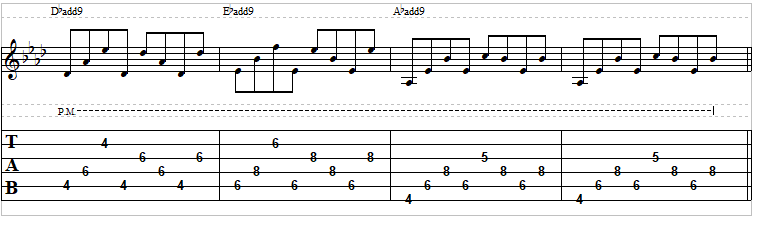
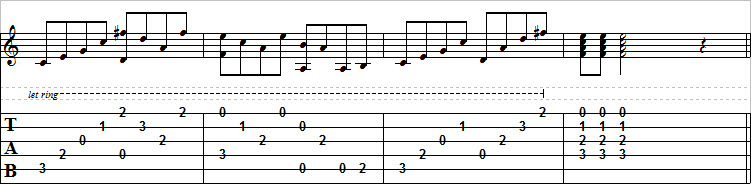
This interlude is easier to play than the main riff that we’ve already learned. There are two variations. In the first, the basic chord progression is C, D, Fmaj7, Am, C, G, D:
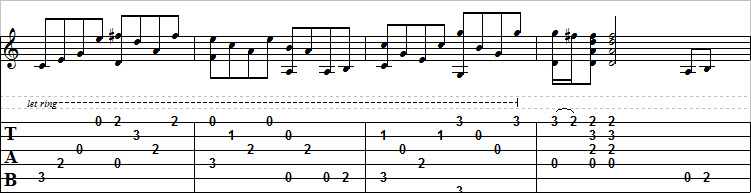
In the variation, in the last 2 measures, the chord progression is slightly altered with the G being replaced by D and it ends on Fmaj7:
Funny Fingers…
Here’s a look at how you might want to fingerpick it:
Hair Of The Dog- Part 2
Chorus
Whole Lotta Love- Led Zeppelin
No guitarist alive has really ever been able to equal the mass appeal that “Zep’s” Jimmy Page does. Robert Plant, the vocalist and frequent harmonica player, pierces your ears just as much as the solos and riffs that Jimmy plays. The band’s music is a fushion of seering rock and hard-as-nails riffs, and their music will continue to impress all of us musicians and music lovers for ages.
Verse Riff

How To Play It
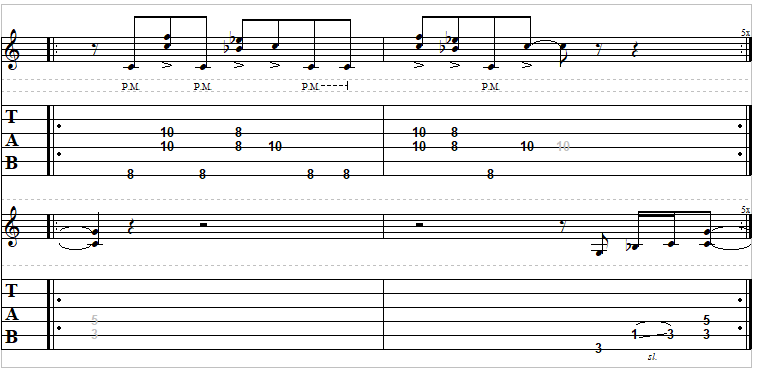
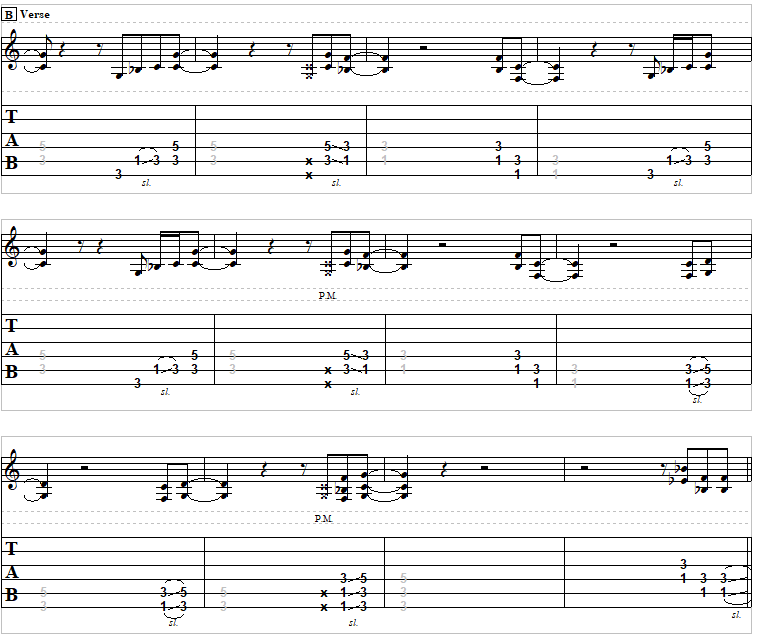
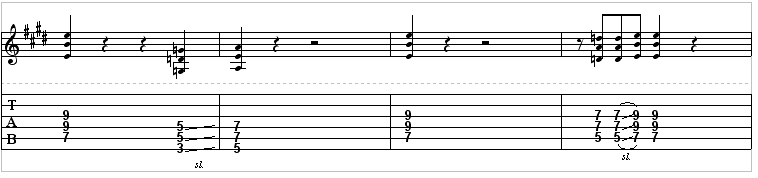
This song is fairly difficult to play right, but both measures are identical. Once you have the first measure, you just need to simply play it twice. To begin, there are a few terms that are necessary to understand the intricacy of how Jimmy Page played the guitar. Here is a quick glossary that will help you in this song:
P.M. – Palm mute – this is performed by muting the notes with your pick hand by lightly touching the string(s) near the bridge.
Short glissando (a type of slide) – this is played by picking
the note to its full value and then sliding in the specified direction ( or / ) at the last possible moment.
Legato slide ( another type of slide )- performed by playing the desired note and sliding to the following note. Only the first note is attacked in this type of slide.
1/4 bend – quarter note bend – a quarter note bend is performed by playing the note and bending the string equal to half of a fret.
Part 1

To start off this song, use your 1st finger and place it on the “A” string on the seventh fret. While keeping that finger there, place your 3rd finger on the ninth fret on the “D” string. Play it once. That is a basic power chord. That is about all that is basic in this song. Next, you will need to play the “low E” open three times, and palm mute all other strings not being played. Now perform the power chord we just saw again. Play it once. Play the open “low E” again three times (palm muting again as well), and then go back to the power chord on the seventh and ninth fret:
Part 2

Once you have done that, you will be performing a “short glissando.” (see above) Slide with your fingers still in the same position as shown above, and then you will go directly into a “legato slide.” The legato slide is from the fifth fret on the “low E” string. Use your 3rd finger
on the “low E.” Play, or “attack” that note and slide directly up to the seventh fret on the “low E” string. There is a quarter note bend coming up. Look again at the glossary above and that will help you
understand how to do it. You begin the end of this measure by placing your 1st finger on the fifth fret on the “A” string and bend that note
equal to half of a fret. (Remember to hit the “D” string open in
this process. You will probably do that by default) You are almost done! The last two notes to be played are simple. Use your 2nd finger to hit the seventh fret on the “low E” and then go back to the quarter note bend. That is it! You just learned the song.
Part 3

The second measure is identical, except right before you go into the “glissando,” hit the power chord once more on the seventh and ninth fret. Good luck!
Riff Resources
Another Lonely Day- Ben Harper
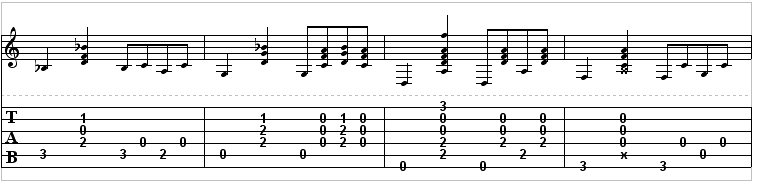
The riff itself isn’t difficult to play, but the moving chord arrangements are a little trickier. In this riff, you will need to know how to play a C chord, an Am chord, an Em chord, and finally a G chord. If you know how to play those, you can struggle through by just playing them in that order. What makes the riff interesting, though, is how he incorporates the chords into his strumming patterns. Notice that you will begin by placing a C chord, and then transitioning into the Am chord by walking the fret with your 2nd finger on the second fret on the “A” string. Notice that once you go into the Am chord, you will immediately let off of it and play the same strings open. You will do this a few times. As far as the timing, the only thing that may throw you off a little is the transitional phrasings from C to Am. Just think like it is a Bob Marley song, and allow your fingers to flow. After you have played the Am chord and transitioned into the Em chord, notice that you are not playing the typical G chord that you may have learned before. The note that you are playing is the root G note. That would be on the third fret on the “low E” string. Practice this song over and over, and you will hear how the chords are so simple, but add a great deal of depth to the overall sound.
Walk Don’t Run- The Ventures
https://vimeo.com/5332263
Main Theme
Here’s what the lead, rhythm, and bass guitars all sound like together:
Lead Guitar

Rhythm Guitar

2nd Theme
Here’s what the lead, rhythm, and bass guitars all sound like together:
Lead Guitar

Rhythm Guitar

Click Here For The Complete Transcription To “Walk Don’t Run” (PDF)
Life By The Drop- Part 2
Ok, we got that opening lick out of the way, so it’s all easier from here on out.
After the opening lick, we’ll spend two measures to establish the rhythm before the vocals come in.
It’s a slow shuffle pattern in the key of A.
Wham- Lonnie Mack
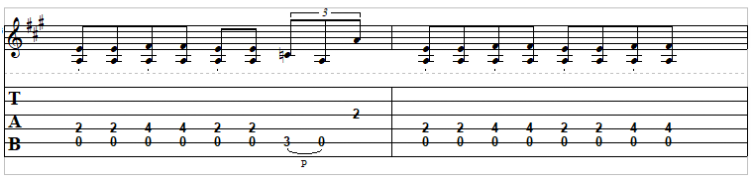
You should have some fun with this intro. It isn’t difficult, and all based on barre chords, except for the very first measure.
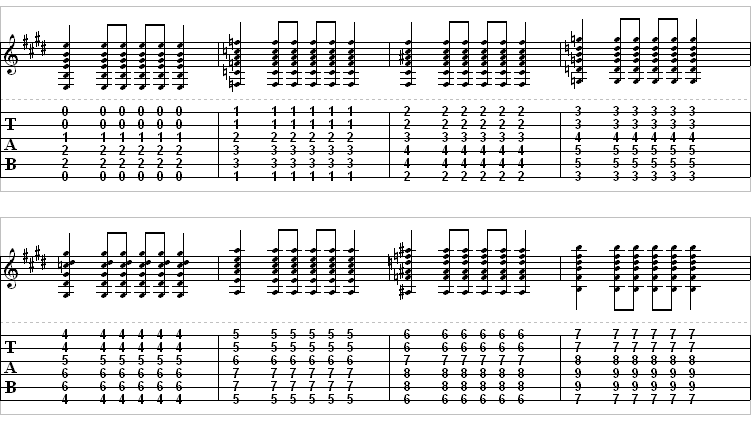
Here’s what it sounds like looped at the normal tempo of 120 bpm:
Sharp Dressed Man 1